ERock provides onsite power systems and related services, addressing a practical problem: businesses need electricity where and when their operations demand it. Its IPO prospectus reported approximately 440 employees as of May 1, 2026. This is a much smaller operating organization than the technology giants that dominate the AI conversation, but its products sit close to one of that industry’s most important constraints.
The appealing story is straightforward. Building computing capacity also requires building the infrastructure to run it. The less comfortable part is that a company can attract major orders while its reported revenue still moves in the wrong direction. ERock’s latest available quarterly figures make that tension impossible to ignore.
What the screenshot actually shows

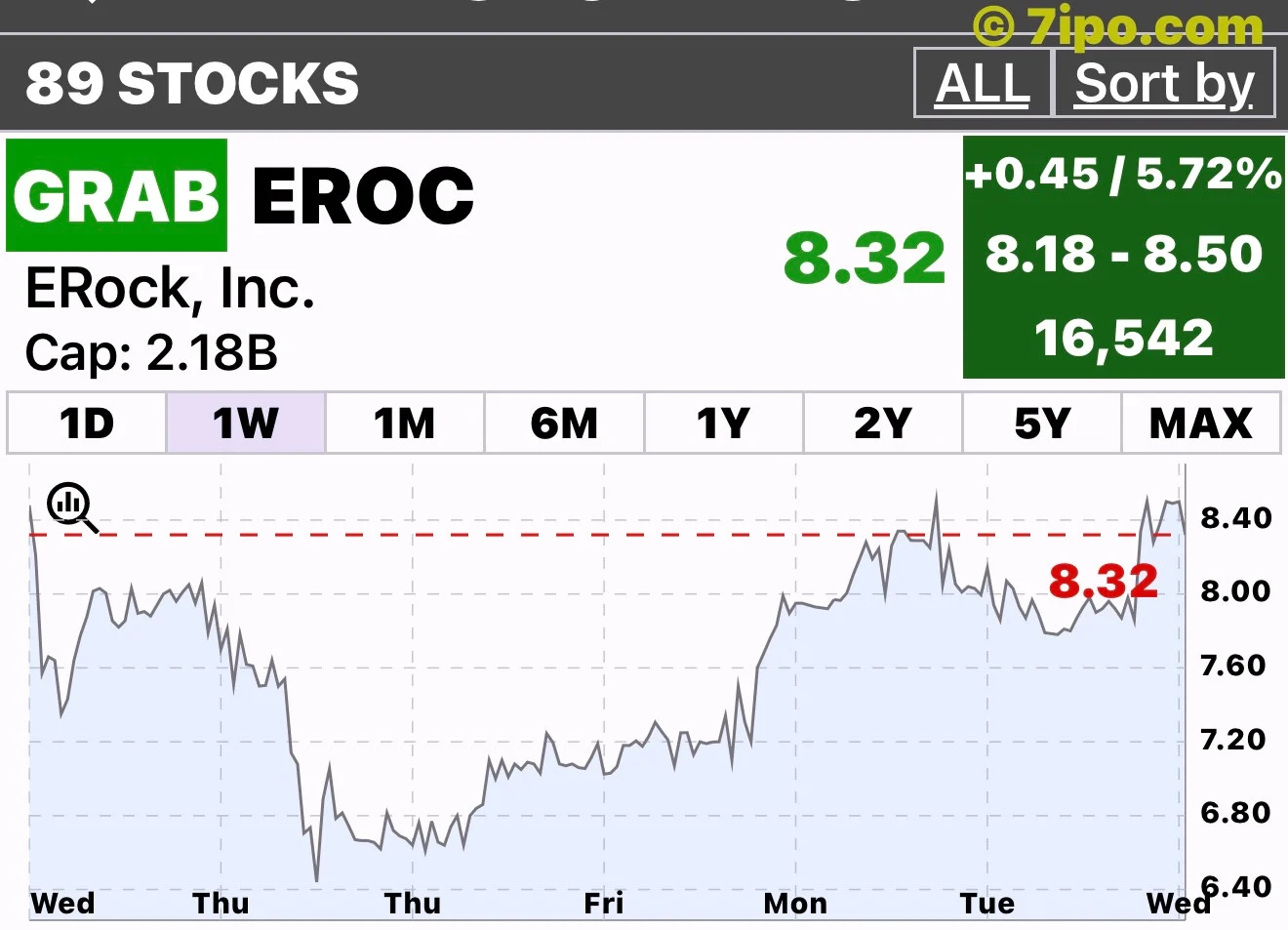
The newer November 11 screenshot shows EROC at $8.32, up 5.72%, with displayed volume of 16,542 and a range of $8.18–$8.50. Its accompanying daily chart covers roughly 4–8 a.m., consistent with a premarket snapshot. These are dated app figures, not an independently verified live feed; the image does not define the volume counter’s session. We do not infer institutional demand from that number.
ERock began public trading on June 10, according to its subsequent company reporting. That makes it a recent listing with a relatively short public record. A fast move attracts attention, but the length of that record matters: investors are still learning how management’s promises translate into regular financial reporting.

Big orders, but a smaller revenue quarter
The company’s second-quarter release reported revenue of $39.878 million, compared with $68.458 million a year earlier. The same release described a $1.7 billion contracted power-system backlog and a 470-megawatt equipment purchase order with Anthropic. Those are different measures of the business, not interchangeable evidence of growth already achieved.

It is good to see identifiable customer commitments behind an infrastructure story. It is less reassuring when investors treat those commitments as though the associated sales and profits are already in the accounts. Backlog can describe tomorrow’s opportunity; revenue tells us what was recognized during the reporting period. Both belong in a fair account of ERock.
Tomorrow’s report is the next real checkpoint

ERock scheduled third-quarter results for November 12 before the market opens, followed by an 8:30 a.m. Eastern conference call. That calendar gives investors an immediate reason to revisit the stock, even without a new announcement on the morning shown in the screenshot.
The useful questions are practical rather than glamorous. How quickly are projects moving toward delivery? What does management say about the timing of orders becoming sales? Does the outlook provide enough detail to distinguish a temporary reporting lull from a more persistent challenge? Those are questions for the report, not answers that can be extracted from a rising share price.

A plausible setup is not a proven catalyst
Our research did not identify a fresh November 11 ERock announcement that establishes why this particular snapshot shows a gain. The earlier power orders and the imminent earnings release provide context. Calling the move earnings anticipation is a reasonable interpretation, but it remains an interpretation.

That distinction prevents an old contract announcement from being repackaged as breaking news. It also keeps the story honest for readers who may see the article after the price has changed. The business case should remain understandable even when the market’s color switches from green to red.
For readers using IPO-Stocks.app to follow new listings, ERock’s next chapter is unusually clear: compare the promised opportunity with the reported execution. A 5.72% screenshot gain gets the company noticed. The results must do the harder work of explaining whether the operating business deserves that attention.